
Meeting Room Technology Explained: Essential Components of a Modern Conference Room
Introduction
The modern meeting room has evolved into a technology-driven collaboration space. While comfortable furniture and attractive interiors remain important, today’s conference rooms rely on integrated audio visual systems that enable effective communication, content sharing, and decision-making.
Whether hosting internal management meetings, board presentations, customer demonstrations, or international conferences, organizations require meeting rooms that deliver clear audio, high-quality video, intuitive controls, and seamless collaboration.
Unlike our previous article, Hybrid Meetings in Egypt: How to Build a Future-Ready Conference Room, which explored the overall concept of hybrid collaboration, this guide focuses on the technology that makes those meeting spaces function efficiently.
Understanding each component helps organizations design meeting rooms that are reliable, scalable, and easy to operate.
The Building Blocks of a Modern Meeting Room
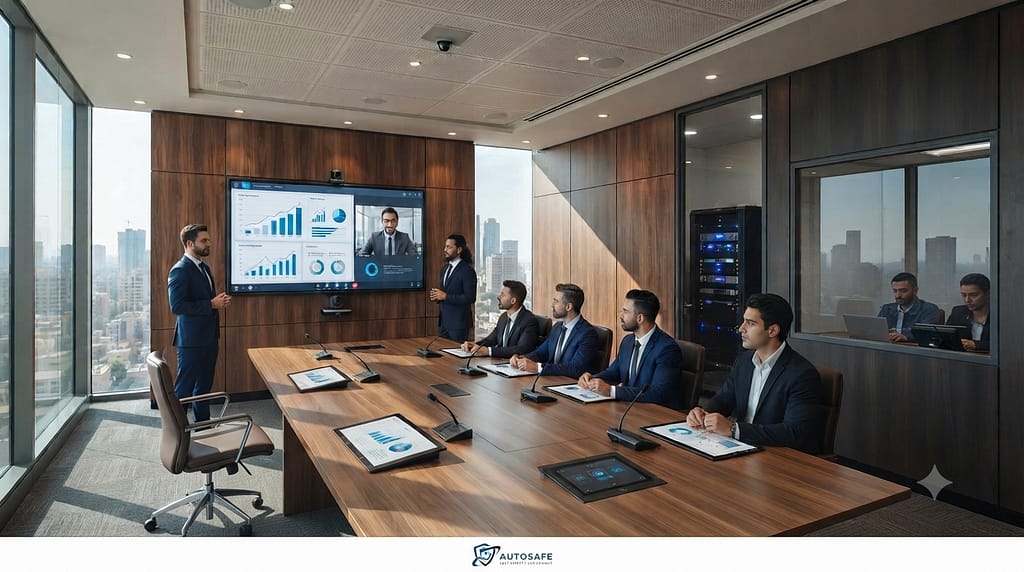
A professional meeting room is much more than a display mounted on a wall. Every component works together to create a seamless user experience where communication feels natural for both in-room and remote participants.
An integrated conference room typically includes display technology, discussion microphones, professional loudspeakers, conferencing cameras, centralized control systems, and, in larger facilities, simultaneous interpretation systems.
Selecting the appropriate combination depends on room size, number of participants, meeting style, and operational requirements.
Interactive Meeting Displays
Large-format displays have become the focal point of modern conference rooms. They are used to present presentations, dashboards, engineering drawings, financial reports, and video conferencing participants.
For executive boardrooms and training facilities, many organizations also deploy interactive touch displays that allow presenters to annotate documents, brainstorm ideas, and collaborate directly on screen.
The display should be selected according to viewing distance, room dimensions, ambient lighting, and image resolution to ensure that every participant has a clear view.
Table Touch Panels
Table touch panels provide participants with a convenient interface for controlling meeting room functions.
Instead of relying on multiple remote controls or manual adjustments, users can manage display sources, room audio, camera presets, lighting scenes, and video conferencing sessions from a single interface.
Centralized control not only simplifies operation but also reduces the need for technical assistance during meetings.
Professional Discussion Microphone Systems
Clear communication begins with professional audio capture.
Discussion microphone systems are designed specifically for conference environments where multiple participants speak throughout the meeting. Depending on the application, systems may include chairman microphones, delegate microphones, wireless discussion units, or fully digital conference systems.
Modern solutions incorporate features such as automatic microphone management, echo cancellation, noise suppression, and priority controls to ensure every participant is heard clearly without unwanted background noise.
Conference Room Sound Systems
Delivering high-quality sound is just as important as capturing it.
Professional conference room loudspeakers are carefully positioned to provide even sound coverage across the meeting space while minimizing echo and feedback.
Unlike consumer audio equipment, commercial sound systems are engineered to maintain speech intelligibility, ensuring that presentations and discussions remain clear regardless of seating position.
Proper acoustic design also contributes significantly to overall meeting quality.
PTZ Conference Cameras
Video has become an essential part of business communication.
Professional conference rooms commonly use PTZ (Pan-Tilt-Zoom) cameras capable of automatically framing speakers, following discussions, and delivering broadcast-quality video to remote participants.
Advanced cameras use AI-assisted speaker tracking, facial recognition, and automatic framing to create a more natural meeting experience without requiring manual camera operation.
Camera placement should always be planned to provide natural eye contact and balanced room coverage.
Simultaneous Interpretation Systems
International organizations, government institutions, conference centers, and multinational corporations often require multilingual communication.
Interpretation systems enable participants to listen to real-time translations through wireless receivers and headphones while interpreters work from dedicated interpreter consoles.
These systems support international conferences, board meetings, training events, and diplomatic discussions where multiple languages are required.
When integrated with the room’s audio visual system, interpretation solutions provide seamless communication without interrupting the meeting flow.
Why System Integration Matters
The effectiveness of a meeting room depends less on individual products and more on how well they work together.
A professionally integrated system allows displays, cameras, microphones, speakers, room control, and conferencing platforms to operate as one solution.
Instead of switching between different devices and interfaces, users can start meetings, share presentations, adjust room settings, and communicate with remote participants through a simple, intuitive control system.
This integration improves reliability while reducing user frustration and technical support requests.
Common Design Mistakes
Many organizations invest in premium equipment but overlook the importance of system design.
Poor microphone placement may create echo or uneven voice pickup. Incorrect camera positioning can make meetings feel unnatural, while inadequate loudspeaker coverage often results in inconsistent audio quality across the room.
Another common mistake is selecting equipment without considering future expansion or compatibility with conferencing platforms such as Microsoft Teams or Zoom.
Successful meeting rooms are engineered as complete systems rather than collections of individual devices.
Frequently Asked Questions
What equipment is required for a professional meeting room?
Most modern meeting rooms include professional displays, discussion microphones, conference speakers, PTZ cameras, centralized control panels, and integration with conferencing platforms.
What is the purpose of a discussion microphone system?
Discussion systems ensure every participant can speak clearly while maintaining controlled microphone management and excellent speech intelligibility.
Why are PTZ cameras used in conference rooms?
PTZ cameras automatically frame speakers, improve remote collaboration, and provide professional-quality video during meetings.
When is an interpretation system required?
Interpretation systems are commonly used during multilingual conferences, international meetings, government events, and large corporate presentations.
Can all meeting room technologies be integrated into one system?
Yes. Modern AV solutions are designed to integrate displays, cameras, microphones, room control, conferencing platforms, and interpretation systems into a unified user experience.
Conclusion
Modern meeting rooms are no longer defined by a conference table and a projector. They have become intelligent collaboration environments where audio, video, control, and communication technologies work together to support efficient decision-making and productive discussions.
Choosing the right meeting room technology requires careful planning, professional engineering, and seamless system integration. From interactive displays and discussion microphones to PTZ cameras and simultaneous interpretation systems, every component contributes to a better meeting experience.
If you’re planning a hybrid workspace, we also recommend reading our guide, “Hybrid Meetings in Egypt: How to Build a Future-Ready Conference Room,” which explores room planning, collaboration strategies, and the business benefits of hybrid workspaces. Together, these two articles provide a complete understanding of modern conference room design.
At AutoSafe, we design and integrate complete meeting room and conference room solutions tailored to each client’s operational requirements. Our expertise includes interactive displays, table touch panels, master control systems, discussion microphone systems, professional audio systems, PTZ conference cameras, simultaneous interpretation systems, video conferencing integration, and complete audio visual solutions. By combining engineering expertise with reliable system integration, we help organizations across Egypt create intelligent meeting spaces that enhance communication, collaboration, and productivity.
