Physical Security Solutions Every Factory Should Implement
Introduction
Industrial facilities face a unique set of security challenges. Unlike office buildings, factories must protect large sites, valuable equipment, production lines, warehouses, raw materials, finished goods, and, most importantly, their employees. Managing vehicle access, contractor movement, visitor entry, and restricted production areas requires a comprehensive security strategy rather than relying on a single security system.
Modern physical security is no longer limited to security guards or perimeter fencing. Today’s factories combine intelligent surveillance, controlled access, automated vehicle management, fire detection, and integrated monitoring systems to create a secure operational environment.
This guide explains the essential physical security solutions every factory should consider and how these systems work together to reduce risks, improve operational control, and support business continuity.
Why Physical Security Matters in Industrial Facilities
Manufacturing plants operate around the clock, often with hundreds of employees, multiple entrances, heavy machinery, and continuous deliveries. Without proper physical security, organizations are exposed to unauthorized access, theft, vandalism, safety incidents, and operational disruptions.
A well-designed security strategy protects both people and assets while providing management with greater visibility and control over daily operations. It also helps organizations comply with internal safety policies and industry regulations.
CCTV Surveillance Systems
Video surveillance is one of the foundations of industrial security. Modern IP CCTV systems provide continuous monitoring of production areas, warehouses, loading docks, perimeter fences, parking areas, and critical infrastructure.
High-resolution cameras combined with intelligent video analytics can detect unusual activity, monitor restricted zones, and support incident investigations. For large industrial sites, surveillance systems also improve operational awareness by allowing security teams to monitor multiple locations from a central control room.
Access Control Systems
Not every employee requires access to every area of a factory. Access control systems ensure that only authorized personnel can enter specific buildings, production lines, laboratories, server rooms, electrical rooms, or administrative offices.
Modern systems support RFID cards, biometric authentication, facial recognition, QR codes, and mobile credentials. Access permissions can be customized according to employee roles, departments, and working hours, improving both security and accountability.
Turnstiles and Pedestrian Entrance Control
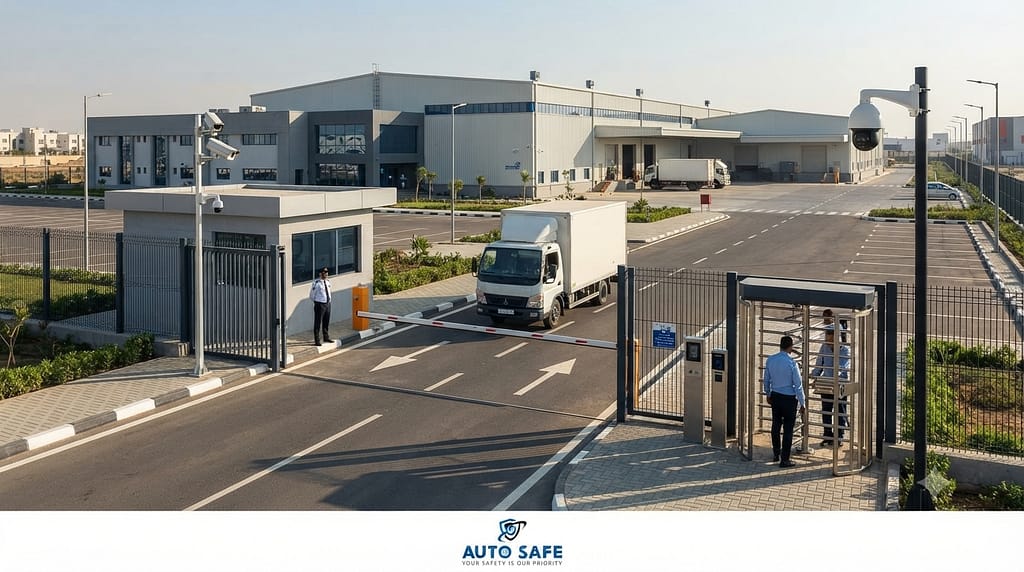
Factories often experience high pedestrian traffic during shift changes. Turnstiles help organize employee movement while ensuring that each person entering the site has been properly authorized.
When integrated with access control systems, turnstiles automatically record entry and exit events, helping organizations improve attendance tracking and reduce unauthorized access.
Different facilities may require tripod turnstiles, flap barriers, swing barriers, or full-height turnstiles depending on operational requirements and security levels.
Vehicle Access Management
Managing vehicle entry is just as important as controlling pedestrian access.
Industrial facilities frequently receive suppliers, contractors, logistics providers, and company vehicles throughout the day. Vehicle barriers, automatic gate systems, and License Plate Recognition (LPR/ANPR) cameras help automate vehicle entry while reducing congestion and improving security.
These systems create a complete record of vehicle movements and allow only authorized vehicles to enter restricted areas.
Perimeter Protection
The perimeter represents the first line of defense for any industrial facility.
Perimeter security may include fencing, outdoor surveillance cameras, security lighting, intrusion detection systems, and controlled vehicle entrances. Combining these technologies enables security personnel to detect and respond to potential threats before they reach operational areas.
For facilities operating 24/7, continuous perimeter monitoring significantly reduces the risk of unauthorized entry.
Fire Detection and Fire Alarm Systems
Security is not limited to preventing unauthorized access. Protecting people and facilities from fire is equally important.
A professionally designed fire detection and fire alarm system provides early warning, allowing occupants to evacuate safely while minimizing damage to equipment and production processes. Depending on the facility, systems may include smoke detectors, heat detectors, manual call points, sounders, strobes, and voice evacuation integration.
When integrated with access control systems, emergency exits and evacuation procedures can be managed more efficiently during critical incidents.
Public Address and Emergency Communication
Large factories require reliable communication during both daily operations and emergency situations.
Public address systems allow security teams to broadcast announcements, operational messages, and emergency instructions across production areas, warehouses, offices, and outdoor spaces. During an evacuation, clear voice communication helps direct employees safely and efficiently.
Centralized Security Management
While each security system provides value individually, the greatest benefit comes from integration.
A centralized security platform allows CCTV cameras, access control, turnstiles, vehicle barriers, intrusion alarms, and fire alarm systems to operate together. Security personnel can monitor alarms, verify incidents through live video, control entrances remotely, and generate detailed reports from a single interface.
This integrated approach improves response times, reduces operational complexity, and provides better visibility across the entire facility.
Common Security Mistakes in Factories
Many factories invest in individual security products without developing a complete security strategy.
Some facilities focus solely on surveillance while neglecting access control. Others install barriers without integrating them with employee authentication systems. In some cases, security systems are added over time using equipment from different manufacturers, resulting in limited compatibility and inefficient operation.
Planning security as an integrated solution rather than as separate products delivers greater long-term value and simplifies future expansion.
Frequently Asked Questions
What is the most important security system for a factory?
There is no single solution. Effective factory security combines CCTV surveillance, access control, perimeter protection, fire alarm systems, and centralized monitoring to create multiple layers of protection.
Why are turnstiles used in factories?
Turnstiles control pedestrian access, reduce unauthorized entry, and integrate with access control systems to record employee and visitor movements.
What is ANPR or LPR in factory security?
Automatic Number Plate Recognition (ANPR/LPR) uses cameras to identify vehicle license plates and automate entry for authorized vehicles while recording all vehicle movements.
Should security systems be integrated?
Yes. Integrating CCTV, access control, vehicle barriers, fire alarms, and other systems improves operational efficiency, simplifies monitoring, and enables faster incident response.
How often should factory security systems be reviewed?
Security assessments should be conducted periodically and whenever facilities expand, production processes change, or new operational risks are introduced.
Conclusion
Protecting a factory requires more than installing cameras or employing security personnel. Modern industrial facilities benefit from a layered physical security strategy that combines surveillance, controlled access, perimeter protection, vehicle management, fire detection, and centralized monitoring into one coordinated system.
By designing security around operational risks rather than individual products, organizations can improve employee safety, protect valuable assets, reduce operational disruptions, and create a more resilient manufacturing environment.
At AutoSafe, we design and deliver integrated physical security solutions for factories, industrial facilities, warehouses, logistics centers, and manufacturing plants across Egypt. Our expertise includes CCTV surveillance systems, access control, turnstiles, vehicle barriers, ANPR/LPR cameras, fire alarm systems, public address systems, structured cabling, and complete security system integration. By combining engineering expertise with reliable technologies, we help industrial organizations build safer, smarter, and more secure facilities.
