
QR Code Turnstile Gates: Complete Guide to QR Access Control in Egypt
What Is a QR Code Turnstile Gate?
A QR code turnstile gate is a pedestrian access control gate that uses QR code technology to verify an authorized person before allowing entry or exit. Instead of using a traditional access card or biometric credential, the user presents a QR code to a compatible reader installed at the turnstile.
Once the QR code is verified by the access control system, the turnstile releases and allows the person to pass.
QR code authentication can be integrated with different types of turnstiles, including tripod turnstiles, flap barriers, swing gates, speed gates, and full-height turnstiles, depending on the security requirements and application. Modern turnstile systems can also combine QR authentication with RFID cards, fingerprint recognition, or facial recognition.
For businesses and organizations in Egypt, QR-based access provides another flexible option for controlling pedestrian movement while maintaining electronic access records.
How Does a QR Code Turnstile Gate Work?
The operation of a QR code turnstile is based on a straightforward access verification process.
A QR code is generated and assigned to an authorized user. The code can then be displayed on a smartphone or printed, depending on the system configuration.
When the user approaches the turnstile, the QR code is presented to the integrated QR reader. The reader scans the code and communicates with the access control system to determine whether the credential is authorized.
If the QR code is valid, the access control system sends an authorization signal to the turnstile, allowing the gate to open.
The basic process can be summarized as:
QR Code → QR Reader → Access Control System → Authorization → Turnstile Opens
This approach allows organizations to control access electronically without relying exclusively on physical access cards.
Modern turnstile systems can communicate with access-control controllers through interfaces such as TCP/IP, RS485, Wiegand, or other supported integration methods, depending on the equipment selected.
Why Use QR Code Access Control With a Turnstile?
Traditional access control commonly relies on RFID cards, proximity cards, fingerprints, or facial recognition. QR code access provides an additional authentication method that can be particularly useful when an organization needs temporary, digital, or contactless credentials.
One of the main advantages is that users do not necessarily need to carry a physical access card. A QR code can be displayed directly from a smartphone, making the authentication process convenient and easy to deploy.
QR authentication can also be configured alongside other credential technologies rather than replacing them completely.
For example, an organization may use:
- RFID cards for permanent employees
- QR codes for temporary authorized users
- Facial recognition for selected entrances
- Fingerprint authentication for specific applications
The appropriate combination depends on the site’s security requirements, traffic volume, operating environment, and access-control architecture.
Key Benefits of QR Code Turnstile Gates
Contactless Access
QR authentication allows users to present a digital credential to the reader without physically inserting or handing over an access card.
This can provide a convenient access experience while reducing dependence on physical credentials.
Flexible Access Credentials
QR codes can be used as digital access credentials where the system supports this functionality. This makes them suitable for applications where access permissions may need to be issued, changed, or revoked electronically.
Reduced Dependence on Physical Cards
Organizations using QR authentication can reduce the number of physical cards required for certain access scenarios.
This can be especially useful for facilities with multiple categories of users or locations where temporary credentials are required.
Fast Access Verification
A properly designed QR access-control system can verify credentials quickly, helping maintain smooth pedestrian movement through controlled entrances.
This is particularly important in facilities with high pedestrian traffic, where slow authentication can create queues.
Integration With Access Control Systems
QR readers can be integrated with access-control controllers and turnstile gates to create a complete electronic access solution.
The turnstile itself becomes part of a larger security infrastructure rather than operating as an independent gate.
QR Code Turnstile vs. Traditional Access Cards
QR code and RFID card access each have advantages, and the right choice depends on the project.
| Feature | QR Code Access | RFID Card Access |
|---|---|---|
| Physical card required | No | Yes |
| Smartphone compatible | Yes | No |
| Contactless authentication | Yes | Yes |
| Easy temporary credential use | Yes | Possible |
| Employee access | Suitable | Excellent |
| Permanent credential | Suitable | Excellent |
| Integration with turnstiles | Yes | Yes |
| Suitable for high-traffic entrances | Yes | Yes |
QR access should not necessarily be considered a replacement for RFID or biometric authentication. In many projects, different authentication methods can be integrated into the same access-control architecture.
The best solution depends on the required security level, user population, traffic conditions, and existing infrastructure.
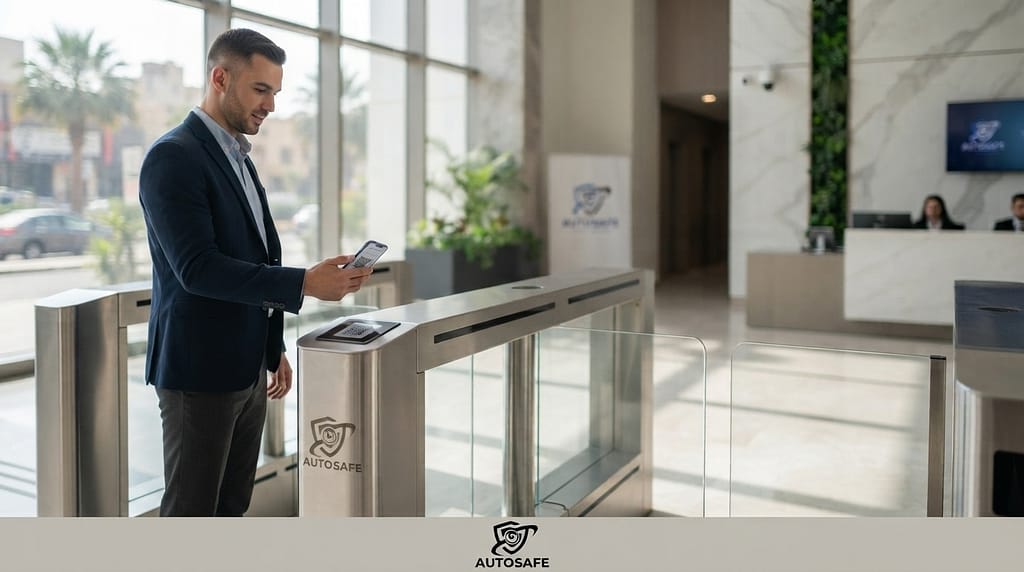
Types of Turnstile Gates That Can Use QR Code Access
QR code authentication is not limited to one specific type of turnstile. The appropriate gate depends on the building layout, security requirements, pedestrian flow, and level of protection required.
Tripod Turnstiles
Tripod turnstiles are a practical option for controlled pedestrian entrances in offices, factories, gyms, and other facilities.
They provide controlled single-person passage and can be integrated with QR readers and other access-control technologies.
Flap Barrier Turnstiles
Flap barriers are commonly selected for modern commercial and corporate environments where appearance, controlled pedestrian flow, and rapid authentication are important.
They can be equipped with QR readers as part of an integrated access-control solution.
Swing Gates
Swing gates can provide wider passageways and may be suitable where accessibility or movement of equipment needs to be considered.
Modern swing barrier systems can support multiple authentication technologies, including QR codes.
Speed Gates
Speed gates are designed for environments where a modern appearance and efficient pedestrian throughput are important.
They are commonly considered for corporate buildings, premium commercial facilities, and other projects where entrance design is an important consideration.
Full-Height Turnstiles
For industrial facilities and sites requiring a higher level of physical security, full-height turnstiles can provide controlled pedestrian access while creating a more secure physical barrier.
The selection of a full-height turnstile should consider outdoor exposure, construction materials, traffic levels, emergency requirements, and the selected access-control technology.
Where Can QR Code Turnstile Gates Be Used in Egypt?
QR code turnstile systems can be considered for a wide range of facilities in the Egyptian market.
Corporate and Administrative Buildings
Companies can use QR-enabled turnstiles to control access to employee entrances and restricted areas while integrating the gates with their wider access-control infrastructure.
Factories and Industrial Facilities
Industrial facilities often require controlled pedestrian movement between production areas, administrative buildings, warehouses, and restricted zones.
QR access can be incorporated into a broader physical security strategy alongside other authentication technologies.
Commercial Buildings
Commercial and mixed-use buildings can use turnstile gates to establish controlled pedestrian entrances while maintaining a modern architectural appearance.
Schools and Universities
Educational facilities may use controlled pedestrian entrances to regulate access to specific buildings and areas.
The selected authentication method should be based on the institution’s operational requirements and security policy.
Gyms and Sports Facilities
QR-enabled turnstiles can provide a convenient way of authenticating users at controlled entrances where rapid pedestrian access is important.
Construction and Industrial Sites
Temporary or changing access requirements can make digital credentials useful in certain construction and industrial environments.
The turnstile type should be selected according to the site’s physical conditions, security requirements, and expected traffic.
QR Code Turnstile Integration With Access Control
The most important part of a QR code turnstile project is not simply selecting a gate with a QR reader.
The complete system needs to be engineered as an integrated access-control solution.
A typical architecture can include:
QR Code Reader
↓
Access Control Controller
↓
Turnstile Gate
↓
Access Control Software
↓
Centralized Access Records
Depending on the project, the access-control system can also be integrated with other security technologies.
For example, turnstiles may operate as part of a wider security system that includes CCTV surveillance, access control, fire alarm systems, and other light current technologies.
This is particularly important for large commercial, industrial, and corporate projects where different security systems need to operate together.
Important Factors When Selecting a QR Code Turnstile
Choosing the right QR turnstile should begin with the application rather than the hardware.
Several factors should be evaluated before selecting the equipment.
1. Type of Facility
An office building may require a different turnstile design from a factory, industrial site, school, or outdoor facility.
2. Expected Pedestrian Traffic
The number of people passing through the entrance affects the appropriate gate type, number of lanes, and authentication technology.
3. Indoor or Outdoor Installation
Outdoor installations require equipment designed for the environmental conditions of the location, including appropriate materials and protection against weather and dust.
4. Authentication Requirements
The project may require QR only, or QR combined with RFID, fingerprint, facial recognition, or another authentication method.
5. Integration Requirements
The QR reader and turnstile should be compatible with the selected access-control controller and software.
Standard communication interfaces and integration capabilities should be considered during system design.
6. Emergency Operation
Turnstile systems should be designed with appropriate emergency and fire alarm integration so that access-control functions do not compromise emergency evacuation requirements.
7. Physical Security
The physical design of the turnstile is just as important as the authentication technology.
The selected gate should provide the appropriate level of resistance to unauthorized passage, tailgating, forced entry, and other risks identified during the security assessment.
QR Code Turnstile Gates vs. Biometric Access
QR code access and biometric access serve different requirements.
Biometric technologies such as fingerprint and facial recognition authenticate users based on physical characteristics, while QR authentication uses a digital credential.
For this reason, QR access can be useful where organizations want a convenient digital authentication method without requiring every user to enroll a biometric credential.
However, high-security areas may require stronger authentication methods or multi-factor authentication.
The correct approach is therefore not simply to choose the newest technology, but to design the authentication method around the actual security requirements of the facility.
Why Professional Installation Matters
A QR code turnstile is only one component of an access-control system.
Incorrect positioning of the reader, poor network configuration, unsuitable turnstile selection, improper controller integration, or inadequate emergency configuration can affect the reliability of the entire system.
Professional system integration should therefore cover:
Site Assessment → System Design → Equipment Selection → Access Control Integration → Installation → Configuration → Testing → Commissioning
This engineering approach helps ensure that the turnstile operates correctly as part of the overall security infrastructure.
QR Code Turnstile Gate Solutions in Egypt
As organizations across Egypt continue to adopt more integrated physical security systems, QR-enabled access control provides an additional option for managing controlled pedestrian entrances.
The technology can be applied to corporate buildings, factories, industrial facilities, educational institutions, commercial properties, gyms, and other environments where controlled pedestrian access is required.
The most effective solution is not simply choosing a turnstile with a QR scanner. It is designing the turnstile, QR authentication, access-control controller, software, networking, emergency functions, and other security systems as one integrated solution.
Why Choose AutoSafe for QR Code Turnstile Solutions?
AutoSafe provides turnstile gate and access control solutions in Egypt, focusing on the complete system rather than supplying individual hardware components.
Our approach covers system design, equipment selection, installation, configuration, integration, testing, and commissioning according to the requirements of each project.
Whether the requirement is a tripod turnstile for an employee entrance, a flap barrier for a corporate building, a speed gate for a premium facility, or a full-height turnstile for an industrial site, AutoSafe can design the appropriate access-control solution and integrate QR authentication with the required security infrastructure.
With experience in Light Current Systems, Access Control, Security Gates, CCTV, and system integration, AutoSafe delivers integrated physical security solutions designed for the operational and security requirements of projects across Egypt.
Conclusion
QR code turnstile gates provide a flexible approach to modern pedestrian access control by combining physical security with digital authentication.
When properly designed and integrated, QR access can work alongside RFID, biometric technologies, CCTV, and other security systems to create a controlled and reliable entrance solution.
For projects in Egypt, selecting the right turnstile should be based on the facility type, pedestrian flow, security requirements, environmental conditions, authentication method, and integration requirements.
AutoSafe designs and implements integrated QR code turnstile and access control solutions in Egypt, helping organizations improve physical security while maintaining efficient and controlled pedestrian access.
