
Smart Building Integration in Egypt: Connecting Systems for Faster Response and Better Control
Modern buildings are no longer made up of independent systems operating separately. CCTV, access control, fire alarm, Building Management Systems (BMS), and public address systems can communicate with each other to exchange information and trigger coordinated actions.
This is the foundation of smart building integration.
Instead of having operators monitor multiple systems independently, integrated light current systems allow an event detected by one system to automatically trigger an appropriate response in another. This reduces manual intervention, improves situational awareness, and helps security and facility teams respond faster.
For commercial buildings, offices, industrial facilities, hospitals, hotels, and large developments in Egypt, system integration can transform multiple standalone technologies into one coordinated operational environment.
What Is Smart Building Integration?
Smart building integration is the process of connecting different building systems so they can exchange information, monitor status, or trigger actions based on predefined events.
For example, when a fire alarm is activated on a specific floor, the integrated system can automatically:
- Display the relevant CCTV cameras for that floor.
- Mute background music through the public address system.
- Broadcast an evacuation message.
- Release designated access-controlled doors.
- Send the event to the appropriate monitoring interface.
The important point is that these actions do not necessarily require an operator to manually activate every system.
The integration creates a relationship between the event and the required response.
Why Is System Integration Important for Smart Buildings?
A building may have advanced CCTV, access control, fire alarm, BMS, and public address systems, but operating them independently can create delays and information gaps.
An operator may need to identify an alarm on one platform, open another system to verify the situation, contact another department, and then manually initiate the required response.
With properly engineered integration, these steps can be connected.
The objective is not simply to place multiple systems on one screen. The real value is creating automated communication between systems so that important events can generate coordinated responses.
This can help organizations achieve:
Faster response: Critical events can automatically trigger predefined actions.
Better visibility: Operators can receive related information from multiple systems.
Reduced manual intervention: Routine responses can be automated.
Improved incident investigation: Events from systems such as access control and CCTV can be associated for better verification.
Centralized monitoring: Facility and security teams can monitor system status and events from a coordinated environment.
Common Smart Building System Integrations
Different systems can be integrated depending on the building’s requirements, available interfaces, and manufacturer capabilities.
The following examples demonstrate how common building systems can exchange information.
| System A | System B | Integration Link | Example Function | Main Advantage |
|---|---|---|---|---|
| BMS | CCTV | Network / TCP-IP / SNMP | Monitor VMS and camera health status | Centralized equipment monitoring |
| BMS | Public Address | Network / TCP-IP | Receive status of core PA devices | Better system health visibility |
| BMS | Access Control | Modbus or supported interface | Monitor panels, servers, and door status | Centralized access system monitoring |
| Fire Alarm | CCTV | Ethernet I/O / dry contact | Trigger cameras for the affected floor | Faster visual verification |
| Fire Alarm | Public Address | Dry contact / control module | Mute music and trigger evacuation messages | Faster emergency communication |
| Fire Alarm | Access Control | Dry contact / control module | Release designated doors | Faster emergency response |
| Access Control | CCTV | Software/API/network integration | Associate access events with video | Better verification and investigation |
The exact integration method depends on the equipment manufacturer, system architecture, available protocols, and project requirements.
BMS and CCTV Integration
A Building Management System (BMS) can be used to monitor the health and status of connected building technologies.
For CCTV infrastructure, integration can allow the BMS or monitoring platform to receive information related to the health of video management systems and cameras.
Depending on the architecture, protocols such as SNMP can be used to monitor device health and network status.
This can help facility teams identify issues such as communication failures, unavailable devices, or system faults without manually checking every camera or component.
The objective is not necessarily to control the CCTV system from the BMS. In many projects, the primary benefit is system health monitoring and centralized visibility.
Fire Alarm and CCTV Integration
One of the most valuable examples of smart building integration is the connection between fire alarm systems and CCTV.
Imagine a fire alarm being activated on a specific floor.
Instead of an operator manually searching through hundreds of cameras, the fire alarm event can trigger the CCTV platform to display the cameras associated with the affected floor or zone.
This provides immediate visual information about the area where the alarm occurred.
The result is a faster understanding of the event and better support for the security and emergency response teams.
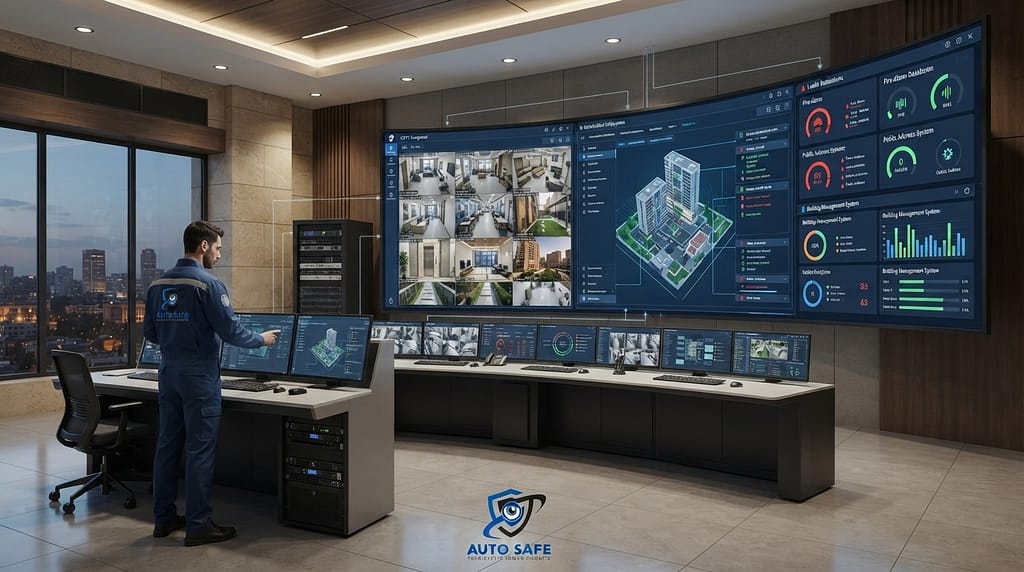
Example
Fire alarm detects an event → Integration sends a trigger → CCTV displays cameras assigned to the affected area → Operator visually verifies the situation.
This type of integration can be particularly valuable in large buildings where hundreds of cameras may be installed across multiple floors or zones.
Fire Alarm and Public Address Integration
Fire alarm integration with public address systems can support emergency communication.
During normal operation, a public address system may be used for announcements or background music. When a fire alarm event occurs, an integrated trigger can automatically interrupt normal audio activity and activate a predefined emergency message.
For example:
Fire alarm event → Trigger received by PA system → Background music is muted → Emergency evacuation message is broadcast.
This reduces the time required for manual intervention and helps ensure that emergency communication is delivered quickly.
The exact functionality depends on the fire alarm and public address architecture and the applicable life-safety requirements of the project.
Fire Alarm and Access Control Integration
Access control is another important system that can be connected to the fire alarm infrastructure.
During an emergency, designated access-controlled doors may need to be released according to the approved emergency strategy.
A fire alarm signal can be connected to access control through an appropriate control module, relay, or dry-contact interface, depending on the system design.
The sequence can be:
Fire alarm activation → Control signal → Access control receives the event → Designated doors are released.
This can help support emergency evacuation by reducing the need for security personnel to manually unlock doors.
Importantly, the integration must be designed according to the project’s life-safety strategy and applicable standards. Not every door should automatically be released in every scenario.
Access Control and CCTV Integration
Integrating access control with CCTV creates another powerful security capability.
When a user presents a card, biometric credential, or other authentication method, the access event can be associated with the relevant camera view.
This allows security teams to compare:
Who accessed the area?
with
What actually happened on video?
For example, if an employee’s access card is used to enter a restricted room, the corresponding CCTV footage can provide visual verification of the event.
This supports:
- Faster incident investigation
- Visual verification
- Better access monitoring
- Improved incident reporting
- Easier review of suspicious events
For facilities with sensitive areas, this combination can provide significantly better security visibility than access control or CCTV operating independently.
Network Integration and System Health Monitoring
Not all integration is about triggering actions.
A major part of smart building integration is monitoring the health of connected systems.
Modern buildings depend heavily on network connectivity. CCTV cameras, access control servers, BMS platforms, public address controllers, and other technologies may rely on IP networks to communicate.
Network-based monitoring can help identify system failures before they become major operational problems.
For example, a monitoring platform may receive information about the availability or health of connected devices and alert the technical team when a device or communication path becomes unavailable.
This supports proactive maintenance rather than waiting for users to report a system failure.
The Difference Between Integration and Centralized Monitoring
It is important to understand that centralized monitoring is not the same as system integration.
Centralized monitoring may allow an operator to see information from several systems in one location.
Integration goes a step further.
An integrated system can create relationships between events and actions.
For example:
Monitoring:
Fire alarm → Operator sees the alarm.
Integration:
Fire alarm → CCTV displays the affected area → PA activates the emergency message → designated access-controlled doors respond according to the emergency strategy.
The second scenario creates a coordinated response rather than simply displaying information.
What Makes a Successful Smart Building Integration Project?
Effective integration starts with engineering, not simply connecting equipment together.
Before implementation, the system integrator needs to understand the building’s operational requirements, existing infrastructure, system interfaces, network architecture, security policies, and emergency procedures.
The integration design should define:
- Which systems need to communicate
- Which events should be shared
- What action should occur after each event
- Which communication protocol or interface will be used
- Which systems require monitoring only
- Which systems require automated control
- How events will be logged and reported
- What happens if communication between systems is unavailable
The integration should also be tested through realistic scenarios before commissioning.
Integration Protocols and Interfaces
Different systems can communicate through different technologies.
Common integration methods may include TCP/IP, SNMP, Modbus, APIs, Ethernet I/O, dry contacts, and control modules.
The appropriate method depends on the equipment, manufacturer, software capabilities, system architecture, and required level of integration.
For this reason, system integration should not be treated as simply connecting two devices with a cable. It requires understanding how each system communicates and how the integration should behave during normal operation, faults, and emergency events.
The Goal: One Event, One Coordinated Response
The real value of smart building integration is not simply having multiple systems connected to a common platform.
The goal is to create a coordinated response to important events.
A single event can provide information to several systems and automatically initiate the appropriate response.
For example:
Fire detected
→ CCTV displays the affected area
→ Public address broadcasts the required message
→ Access control responds according to the emergency strategy
→ BMS receives the event
→ Operators receive a coordinated notification
This approach can make buildings more responsive, easier to monitor, and more efficient to operate.
Smart Building Integration in Egypt
As commercial buildings, industrial facilities, residential developments, hospitals, educational institutions, and mixed-use projects in Egypt become increasingly technology-driven, the need for integrated light current systems continues to grow.
Instead of implementing CCTV, access control, fire alarm, BMS, public address, and networking as completely separate technologies, organizations can design these systems as part of a coordinated building infrastructure.
The role of a professional system integrator in Egypt is to understand the requirements of each technology and develop an architecture where the systems can communicate reliably while maintaining their individual functions and safety requirements.
AutoSafe: System Integration for Connected Buildings
AutoSafe provides system integration and light current solutions in Egypt, combining security, safety, communication, networking, audio visual, and building technologies into professionally engineered solutions.
Our system integration approach focuses on connecting the right technologies for the right application, from CCTV and access control integration to fire alarm, public address, networking, and building management interfaces.
From system design and equipment selection to installation, configuration, integration, testing, and commissioning, AutoSafe supports projects through the complete integration lifecycle.
The objective is simple: connect systems, improve visibility, automate the right responses, and help organizations operate safer and smarter buildings.
Frequently Asked Questions
What is smart building integration?
Smart building integration connects different building systems so they can exchange information and respond to predefined events. Common systems include CCTV, access control, fire alarm, BMS, public address, and networking systems.
What is the benefit of integrating CCTV with access control?
CCTV and access control integration can associate access events with video footage, allowing security teams to visually verify users and investigate incidents more efficiently.
Can a fire alarm system trigger CCTV cameras?
Yes. Depending on the system architecture and available interfaces, a fire alarm event can trigger the CCTV platform to display cameras associated with the affected area or floor.
Can fire alarm systems integrate with public address systems?
Yes. A properly designed integration can allow a fire alarm event to trigger predefined public address actions, such as muting background audio and broadcasting an emergency message.
What protocols are used for building system integration?
Integration can use different protocols and interfaces, including TCP/IP, SNMP, Modbus, APIs, Ethernet I/O, dry contacts, and control modules. The appropriate method depends on the systems being integrated and their supported interfaces.
Does system integration require a system integrator?
For complex projects, professional system integration helps ensure that different technologies are properly designed, connected, configured, tested, and commissioned. A system integrator can also define the required event-action relationships and ensure the overall solution meets the project’s operational requirements.
How does smart building integration improve response time?
Integration can automatically connect an event to a predefined action. Instead of requiring an operator to identify an event and manually operate several systems, the integrated architecture can initiate the required response across connected systems, helping reduce delays.
